
CASE STUDY
Construction & Infrastructure100 suppliers. One solution. More than 30 years of trust.
When a supplier changed the material in a longtime customer’s manufacturing process, we went back to the lab to find a way forward.
The challenge
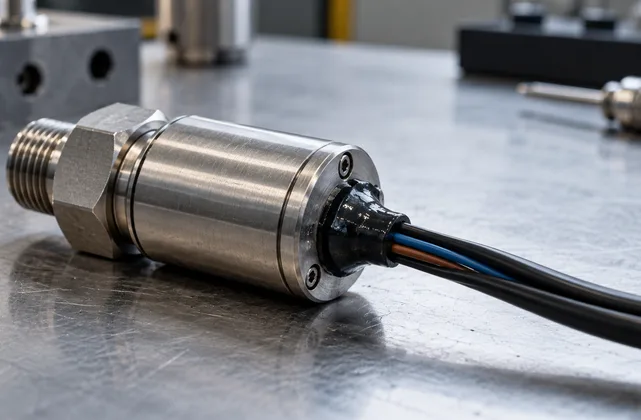
For an industrial sensor manufacturer, keeping moisture out isn’t optional. These sensors operate in hydraulic systems, commercial appliances, and industrial and medical equipment. Water entering through a wire connection can mean a failed sensor—and potentially failed equipment.
More than 30 years ago, one manufacturer’s owner set out to find an epoxy that could reliably seal the point where lead wires exit the sensor housing. He tested products from roughly 100 manufacturers and distributors.
Only one worked.
Ours.
Our epoxy bonded to the PVC wire jacket and maintained the watertight seal the application demanded. It became part of every sensor the company manufactured, and for more than three decades, there was no reason to change it.
Then the wire changed.
An upstream supplier introduced a new PVC jacket containing more plasticizer, the additive that gives the material its flexibility. The difference was enough to prevent our epoxy from bonding.
Suddenly, a manufacturing process that had worked for decades had a problem. Finding a replacement could mean another lengthy supplier search, extensive testing, and potential disruptions to production.
Back to the lab
The manufacturer didn’t start calling new suppliers. He came back to us.
After more than 30 years of working together, he had a pretty straightforward question: If he sent us ten feet of the new wire, could we figure out how to make the epoxy stick?
We could.
Our chemists worked directly with the actual wire, rather than relying on a specification sheet or a description of the problem. We adjusted the formulation to accommodate the new material and sent back a sample for testing.
Of course, getting the epoxy to bond was only the beginning.
The manufacturer’s assembly team evaluated how it behaved in production, including its odor, clarity, and ability to flow into narrow openings. Engineers followed with wire-bond pull tests and underwater pressure tests at up to 125 psi.
The reformulated epoxy passed, and the manufacturer put it into production.
Later, when the company needed a flame-retardant formulation for its UL-listed sensors, we developed that, too.
The outcome
The best part of this story might be what didn’t happen.
Our customer didn’t have to start over with a new supplier. There was no gap in shipments. And the people buying the finished sensors had no reason to know anything had changed.
They simply continued receiving the same reliable, watertight products they expected.
We’ve worked with this manufacturer for more than three decades. In that time, materials have changed, requirements have evolved, and new challenges have come along.
That’s the nature of manufacturing. A formulation that works beautifully today might need to do something different tomorrow.
Our job is to understand the problem and figure out what the chemistry needs to do next.
We’ve had other guys come in and ask, and I said, not unless you can beat these guys. And nobody has.
When the material changes, the solution can too.
Working with a substrate that won’t bond, a new material specification, or a manufacturing challenge without an off-the-shelf answer? Tell us what you’re working with. We’d like to take a look.