
CASE STUDY
Aerospace & Specialty IndustrialSome problems don’t come with a data sheet.
When a custom coil manufacturer brings us a challenge that standard materials can’t solve, we get to work figuring out what can.
The challenge
Building custom coils means working with a lot of unknowns.
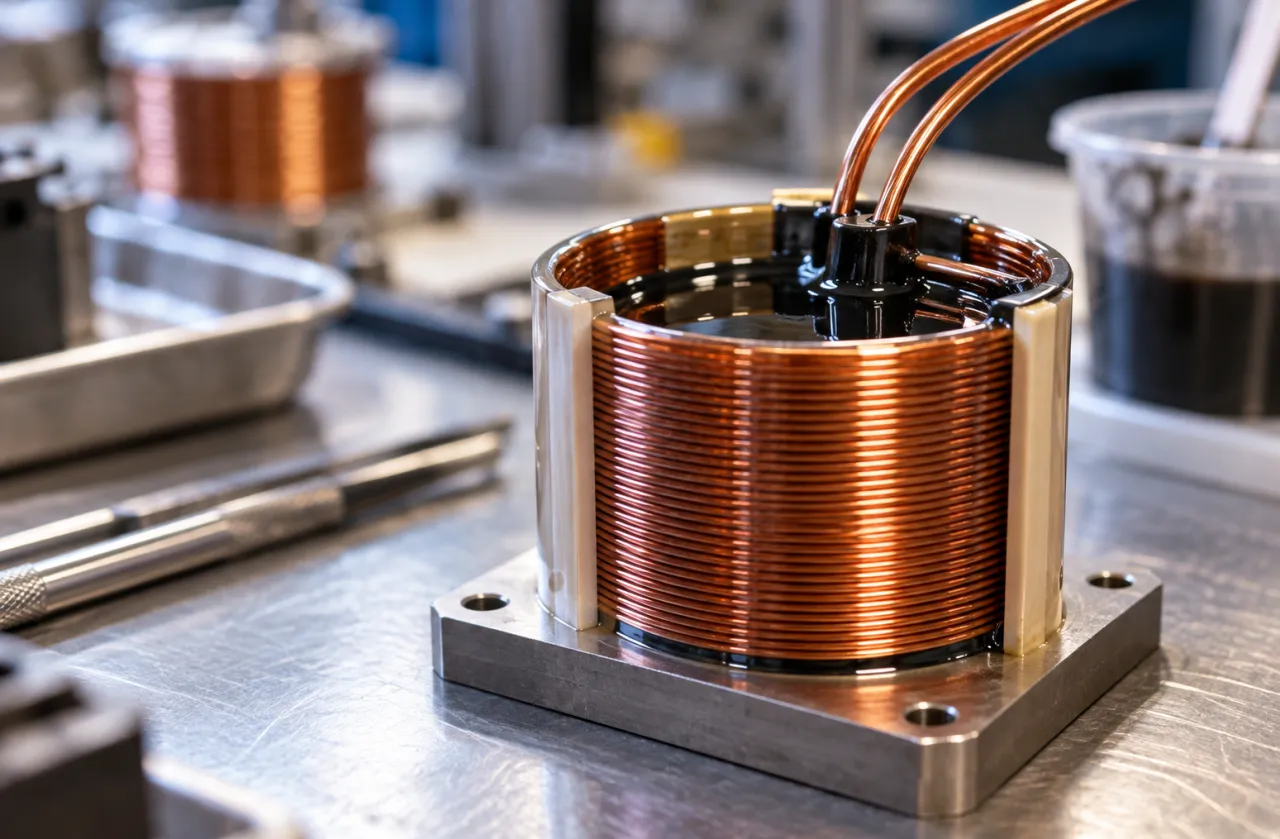
Our customer manufactures specialized coil assemblies for research laboratories, medical devices, and aerospace applications. Their customers don’t always arrive with a finished specification. Sometimes they arrive with an idea, a set of performance requirements, and a problem they need someone to solve.
That’s the nature of custom manufacturing. And it means the materials going into these assemblies need to be every bit as adaptable as the people building them.
One aerospace project presented a particularly difficult challenge.
The finished assembly needed an encapsulant capable of withstanding temperatures ranging from approximately 450°F down to −32°F. That’s an enormous swing for a resin, and the thermal shock alone presented a serious engineering challenge.
There wasn’t a standard formulation with a data sheet that could promise that kind of performance, and the customer still needed to deliver the part.
Straight to the lab
When our customers run into a problem like this, they don’t have to work their way through a complicated support system; they call us.
For the aerospace project, we were candid about the limits of the chemistry. Rather than promise performance we couldn’t substantiate, our chemists developed a formulation with the widest temperature range we could reasonably achieve.
The coil manufacturer took that information back to its customer, who reviewed the proposed material and approved it for the build.
Not every formulation gets there on the first try, of course. When a sample doesn’t meet the requirements, we adjust it and try again. Sometimes that means changing the chemistry. Sometimes it means changing how the material is handled.
For applications where operators need greater control over curing, for example, we supply a three-part system with the catalyst packaged separately. That gives the production team the flexibility to decide exactly when the resin begins to cure.
The goal isn’t simply to find a material that works on paper. It’s to find one that works in the customer’s actual manufacturing process.
Chemistry is only part of the equation
There’s another piece of this relationship that matters just as much: reliability.
Our customer’s business runs on promised delivery dates. A delayed material shipment doesn’t just affect their production schedule. It can hold up a research project, a medical-device build, or an aerospace program waiting for a finished component.
We manufacture their everyday resins to order, so they arrive with their full shelf life. And when an order comes in at the last minute, we understand what’s at stake.
The result is a relationship that gives this manufacturer the confidence to take on unusual projects, knowing they have people they can call when the specifications get complicated.
The outcome
The aerospace project moved forward with a material the customer’s own customer had reviewed and approved.
More broadly, applications that didn’t fit an existing catalog became projects the manufacturer could confidently quote. They had access to chemists who would work through unusual requirements with them, and a supplier who understood the importance of keeping production moving.
We can’t always say yes to every specification. Sometimes the chemistry has limits. But we can listen, investigate, and give our customers a clear answer about what’s possible.
And when there’s a way to make it work, we’re happy to roll up our sleeves.
I can physically call you guys, and you can give me an answer to the best of your ability, or do the research and get back to me. You can’t beat that human interaction.
Have a problem that doesn’t fit a data sheet?
Tell us what you’re trying to build, what the material needs to withstand, and where the standard options are falling short.